> For the complete documentation index, see [llms.txt](https://docs.shred.fi/llms.txt). Markdown versions of documentation pages are available by appending `.md` to page URLs; this page is available as [Markdown](https://docs.shred.fi/documentation/yield-and-strategy.md).
# Yield & Strategy
The yield generated by SHRED comes directly from funding fees paid by traders on perpetual futures exchanges like Hyperliquid. These funding payments are real, market-driven revenues — not emissions or subsidies. \
\
SHRED targets a stable 10-15% APY\* on stablecoins such as USDC (and eventually USDT). To achieve this, the protocol employs a delta-neutral arbitrage strategy. More detailed information on the strategy mechanics can be found below.
To smooth out fluctuations, SHRED maintains a buffer fund. This reserve absorbs short-term dips in funding rates, helping users receive stable yields. While prolonged negative funding rate environments could lower yields, such periods have historically been rare and temporary.\
\
*\*Note - The target 15% APY, which we call the watermark, is subject to change in the future due to market conditions such as prolonged negative funding rates during a bear market.*
#### **The Trading Strategy**
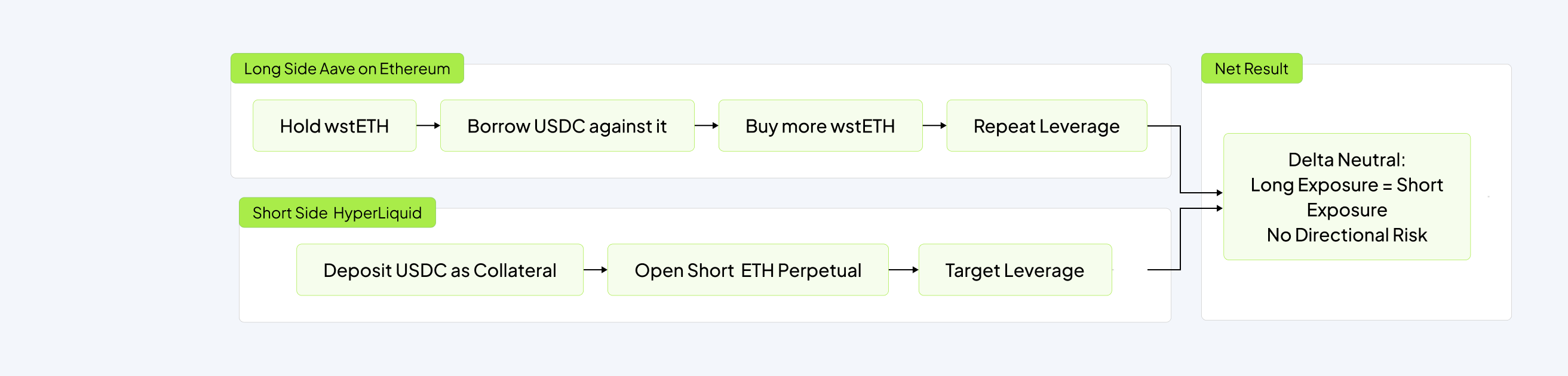
The strategy is "delta-neutral," meaning it holds offsetting long and short positions so that ETH price movements don't cause profits or losses. Instead, the strategy earns yield from other sources.
**Yield and Cost Breakdown:**
| **Side** | **Yields** | **Costs** |
| ------------------------------------- | ----------------------------------------------------- | ------------------------------------- |
|
Long (Aave on Ethereum)
| wstETH staking yield + Aave supply interest on wstETH | USDC borrow rate on Aave |
|
Short (Hypercore Perp DEX)
| Funding rate payments (when positive) | Funding rate payments (when negative) |
The funding rate on perpetual futures fluctuates based on market conditions. When more traders are long, shorts get paid (positive yield for us). When more traders are short, longs get paid (a cost for us).
**Rebalancing**
The strategy requires periodic rebalancing to maintain healthy positions and avoid liquidation. There are two types:
USDC Rebalancing (no cost, preferred)
This moves USDC between the two sides without changing position sizes:
| **If ETH price...** | **What happens** |
| ------------------- | ------------------------------------------- |
| Goes up | Long side gains value, short side loses |
| Goes down | Short side gains PnL, long side loses value |
This keeps both sides healthy and away from liquidation, with no trading fees.
**Exposure Rebalancing (has costs)**
This actually changes the size of the positions. It's needed when:
New deposits increase total NAV (need bigger positions)
Withdrawals decrease total NAV (need smaller positions)
Large price moves require resetting the hedge
Exposure rebalancing incurs costs like spot swap fees, slippage, and perpetual trading fees, so we minimize how often it's needed.
**Triggers**
Rebalancing is based on LPM thresholds (how close to liquidation), not fixed time intervals.
**Yield Determination**
The advertised yield rate is determined through:
**Backtesting**
1. Running the strategy against historical data to estimate returns.
2. Live Testing ("Proof of Profit") — Running with real capital to validate performance.
3. Conservative Launch — Starting with a rate we're confident we can sustain.
If market conditions change significantly (e.g., sustained below optimal funding rates), the target rate may be adjusted downward. A buffer fund (\~1% of total value) helps smooth short-term volatility.